Thursday, April 7, 2011

Nicholas Jones

Nicholas Jones:
In lieu of the recent assignment given, I decided to find book artists to talk about. Nicholas Jones is an incredible book artist that does not seem to stick to one type of transformation.
                      Conch, 2006
This is a beautiful piece by Jones that has been cut and folded into this shell like shape that he calls Conch. There is no longer a cover to the book and the folded pages themselves become the cover, the ‘shell’, almost as if it is protecting whatever is inside. Because we cannot see any of the words on the pages clearly, I am assuming that the text of this book is completely arbitrary. The simplicity of this piece makes it even more contemplatable, because it makes you wonder how it was done; it can’t be as simple as it looks right? I think that Jones has developed a strong relationship with this material, and that relationship helps inform his work.


I could not find a year or a name for this one, but I am assuming because it is like the previous picture I have shown that it was made around the same time. This I think is absolutely beautiful. It’s as if he just took the pages, without cutting, and just folded them up into this incredible shape. It has the same formal qualities as Conch but the twisting that happens at the middle of the two objects is phenomenal, and it really makes me question how it was done. I love the book pages that he chose to keep exposed, they might even be the inside of the covers because it looks like he used all the inside pages to make those beautiful spiral like objects.

Boy this guy is really difficult to find dates on…but hey! Its books, and they just keep on coming to him; they have a history of their own so who needs dates I suppose. This one is beautiful to me as well, it is clear that the layers of these pokey pieces are not just random. They layer from precisely and are bigger and smaller in certain areas. The colored layers I’m assuming were part of the original book, but the way he has exposed them keeps your eye moving across the vibrating layers of these cut pages.

This one really speaks to me. Not only is the caring of the hand quite pristine and beautiful, but I think the meaning really speaks for itself. Jones gets most of his books from a local library that are donated to him. And I think this adds to this idea he is portraying here. When you go to a library, and you pick out that book you need for pleasure, that one class, research, or pretty pictures, do you ever imagine how many other people have touched that book? A book’s life is long, and it holds the records of every single person that has ever touched it, moved it, or read it. This simple piece is one of my favorites of Jones.

Monday, April 4, 2011

Body Artists

Rebecca Horn:
Horn is most well-known for the way she extends the body in her art. This usually consists of her performing these extensions, and they are recorded with film or photography. Many things that she does either attaches to the body to make it seem as if it could do more than we can already, and some of the ‘costumes’ she creates actually inhibit the body. She plays with the idea of our body and the space around us. She also does very feministic sculptures that will represent either a woman’s breasts or reproductive organs.

Unicorn, 1970


High Moon, 1991

Rachel Whiteread:
Whiteread is most known for her sculptures that are casts of the inside of spaces. She actually won the Turner Prize for casting the inside of chairs and removing the chairs. This pertains to the body immensely. It is almost ghost like and it completely transforms the idea of space. It is the space of a person, a space that a person is supposed to be in, and I think that leaves interpretation for any story that someone can feel when looking at her work. She even does entire spaces of the inside of houses!
Sixteen Spaces, 1995

House, 1994

Stairs, 2001
Louise Bourgeois:
Bourgeois started with drawings and eventually came to sculpting. Her work relates to the body because she mainly focuses on the sexuality of male and female bodies. The female and male bodies are almost always references in her work. Most of these anthropomorphic shapes are quite organic in nature and sometimes a sheer slap in the face surprise.
Arch of Hysteria, 1993
Janus Fleuri
Nick Cave:
Cave works with a sort of extension of the body. The costumes that he makes are certainly shocking and incredible pieces. When they are still they tell a different story than when there is a person inside moving the costume.
Janine Antoni:
Antoni does a lot of sculpture and performance art, and sometimes both at the same time. Part of her motivation for doing these works that pertain to the body is the idea of using her own body. She has eaten giant cubes of chocolate and lard, washed a soap bust of her face, liked a chocolate bust of her face, trained for tight rope walking, and dipped her hair in paint and painted an entire floor with just her hair. By knowing her own body and making herself do crazy things such as the above, she really learns herself. She takes everyday activities and turns them into something to learn from.
Saddle, 2000

Eureka, 1993

2038, 2000

Loving Care, 1993

Lick and Lather, 1993

Touch, 2002

Sunday, April 3, 2011

Chuck Close

I think the two most amazing words in the world of art today are Chuck, and Close. His inventive way of doing portraits has shocked and awed this contemporary world today.


Self-portrait, 2000
65 x 54½ inches

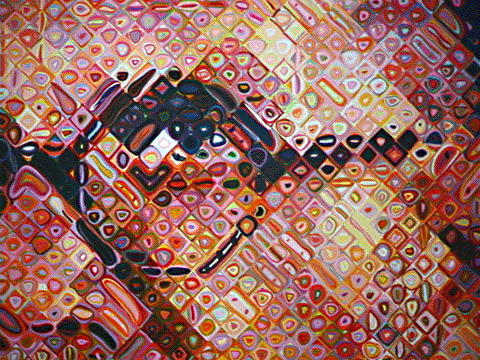
Chuck Close's subjects are his family, his friends, himself, and fellow artists whose faces are described through his distinct and meticulous marks. Working from a gridded photograph, Chuck Close builds his images by applying one careful stroke after another in multi-colors, but he also does this in grey scale. His works, like this one, are generally larger than life. I chose to show the full and detailed shots of this piece because of the immense difference between the two. If you just saw the detail, it would be no more than an abstract, geometrical piece; where the full image creates a face with all the details of chiaroscuro.


Chuck Close, Big Self-Portrait , 1967-1968
acrylic on canvas

This is one of his early works, and you can tell because this is a self-portrait and he’s so young ;) I also chose this piece of his because it shows another style that he does that is very well known and appreciated. The exaggeration of this portrait makes it an idealized realistic painting. You can see every hair and every pore. This is such a famous piece of his and one of my all-time favorites; I just had to show it off.

Brad, 2009
104 x 78 in
This is another example of his idealized form, and yes, it is a celebrity which he does do from time to time.

Robert Gober

Robert Gober’s work often pertains to transforming domestic/everyday objects. He does photography, printing, and even curates his own exhibits, but he is most known for his ability and modern ideas involving 3D work. Sexuality, religion, politics, and nature are some themes that one can perceive in most of his work.

Untitled (Hairy Shoe), 1992
wax, human hair
 4 x 8 x 3 in.

Some of Robert Gober’s work gives you quite a disgusting feeling when you see it. This is real human hair, and one cannot look at a shoe without thinking about putting their foot in it. One thing I do not necessarily like about Gober is that he rarely titles his work, and I feel a title can really lead a viewer in a direction; for instance, I have no idea what he is trying to say here. It is a shoe full of hair. He plays a lot with gender and the body, so maybe because this is a sort of womanly shoe with masculine hair inside plays with mirroring each other.


Untitled, 1990, beeswax, human hair, and pigment, 61.6 x 43.2 x 27.9 cm
This one also plays with the body of a man and a woman. I think this shows the idea that women and men are one in the same, we are alike. It could also be saying that we need each other to survive. On the left it has the woman’s breast and on the right a man’s with hair clear to the belly button. But although they have separate sides, they are one in the same because of this bag like object that they are both on.

Half Buried Sink, 1987
97.2 x 62.2 x 6.4 cm.
Robert Gober did a lot of work with sinks at one point in his career. This one is somewhat different from the others he has done, but I think that is what appealed to me when I stumbled across it. I do not know at what point in his sink era that this was made, but it is almost as if he is killing this object by making it into a burial site.

Untitled (Leg), 1989
beeswax, cotton, wood, leather and human hair
This one is at the Modern Museum of Art. I can’t help but wonder what is on the other side of the wall and where this persons other foot is! I don’t know if this was his point, but it certainly is goofy. I think the realistic nature of this piece is freaky. The real hair I’m sure is what does it. Gober, like the sinks, went through a leg thing as well, and he also used legs in sinks, little teeny legs. He is definitely one who does things out of the box with no purpose it seems.

Susan Graham

Susan Graham
Susan Graham does sculptures mostly using wire and copper, and it mostly consists of animals. She uses a three dimensional drawing on a two dimensional surface and takes a single continuous strand of steel or copper wire and uses it as long as possible. Expression and gesture is important to each animal in her work.


In all of these animals you can see the gesture importance that she has in her work. Although it may not be on purpose, I really enjoyed the way they are displayed in a white room and the way the lighting works because it creates a shadow, and with the linear craziness, it makes the objects look almost blurry! I chose to show the giraffe because it is my favorite animal and also because I think the use of the neck with the wire and the fact that it is just one long wire makes her work look complicated and not easy. I think the birds also show incredible linear quality and I also love the way they are displayed as if they are flying. If animals were made of wire, this is what they would look like.

My Dad’s Gun Collection, 2002
Glazed porcelain
I really enjoy these pieces she created because of the object it portrays and the material that it is made out of. Guns are harsh and dangerous objects and they even look that way. The fact that these are made of something so fragile, and almost looked crocheted, is completely ironic. They look safe and even beautiful. The linear quality that the porcelain has here is exceptional and intriguing. The title to me does not make sense; I just feel that a man, a father, would not own these, and I understand that they are guns, but I do not see how it correlates with the softness of the transformed objects.

Kiki Smith

Kiki Smith is considered a modern feminist artists; her work usually involves women’s bodies. Usually themes of birth, regeneration, and animalistic statements are seen in her work.


Born, 2002
Bronze

This is a great example of Kiki Smith’s shocking and provocative work. The dear is giving birth to a grown woman. Both the dear and the woman are very idealized and majestic looking, and that gives me the feeling that birth is something beautiful and perfect in our world. Here she is linking and showing a connection between animals and humans. I think it maybe says that humans are animals in our purest and most truthful form. We are no better than those that are wild around us. I also think that the woman being bald is interesting; babies are hairless or near hairless when they are born and the fact that this is a grown woman makes one question why Smith decided to do this; I think it is just referring to the birthing process. This sculpture also shows her symbols of renewal and rebirth; in many cultures that is what the deer represents, and I think the woman being bald and full grown also shows this.


Virgin Mary , 1993
wax ,cheesecloth and wood
This figure, with hint from the title, clearly has religious implications that go along with it. I love the attention to detail in anatomy that Smith has paid attention to here. She also did this piece in a bronze cast. The life size element of this piece sort of sends chills down your spine, because it feels as if this think without skin that is so exposed is just living and breathing in front of you; but it brings up another question as to what if this Virgin Mary is dead. There are holes in her wrists and I am not sure if that is on purpose or not, but her son Jesus had those same holes, and maybe she died along with him. Her body is in a very peaceful feeling stance.


Pee Body, 1992.
Wax and 23 strands of glass beads
Smith usually confronts and shows things that are somewhat awkward things to talk about in society. I love this piece because she turns something that socially is not the prettiest thing, into beautiful glass beads. The person here is also in an awkward position and it is again, a woman with no hair. I think this piece also brings us back to birth.


Daisy Chain,1992
Steel chain with five cast bronze elements (numbered three in an edition of three)
I really like this piece because again it deals with the body theme that Smith always presents, and it also makes me feel very deflated. I think that this might be saying that our limbs are some of the most important things we have, or it could be opposite and say that without our inside we cannot support the rest of our body. The chain and the casted elements are very rustic and dirty feeling. I love how Kiki Smith makes you question so much and does not necessarily give you an answer. I think this piece is a good example of that.

Tuesday, March 15, 2011

Judy Pfaff

Judy Pfaff, born in London, England, makes incredible and very organic looking sculptures. She was one of the first to being doing installation art during the 70’s. She has even done work for the stages in theater productions. There is a sense of lightness about her sculptures. Her materials often involve steel, fiberglass, plaster, and natural elements.


Materello, 1992
Woven magnet wire, steel, blown glass
h: 95 x w: 125 x d: 75 in

This is a great example of the use of the materials that she uses in order to make them into organic shapes. There is an extreme amount of curvilinear quality of line in this piece. It is amazing to me that she can use things that are so industrial in nature and turn them into something so organic and natural. My eye seems to always end up in the middle circular object, and I would say that that is the emphasis and focal point from which the other elements emanate from. The almost zigzag shape that starts at the small yellow, natural, caged in element and traveling to the end of crazy lines, seems to defy the gravity of the space. All of the colors are quite natural except for the bright yellow, which I think is part of the blown glass material that she used. I think this extreme color brings our attention back to the hard figure of the steel and wire that seems to entrap the other organic elements.


“…all of the above”, 2007
Vine, steel, black foil, rope, string, UV light, spheres cast from cannon balls, foam board
44ft x 40ft room

The title “…all of the above” definitely helps create a sense for what this instillation is about. It’s almost as if the chaotic stuff in the top of the room is the ‘above’ of the bottom circular elements. There is a definite shift in quality of curvilinear lines that protrude from the ceiling. The vine that was used here was taken from her New York property have been stained with dye and draped across the ceiling as if it is snaking across.  The balls that are hanging from the ceiling make me feel as if the above is descending into the bellow and both are become a part of each other. I also feel that the steps of the white foam circles are trying to ascend in to all that is above. The colors in this space really work well together as the neutral white, black, and greys are offset and contrasted with by the bright blue of the UV light.


“Straw Into Gold”, 1990
Steel wire, glass and tin cans
 9 feet 6 inches x 9 feet 10 inches x 8 feet 4 inches

I chose to show this piece because it sort of shows her development as an artist because this is such an earlier piece. However, she is still playing with the idea of natural and industrial materials being formed into a very organic shape. The lines of the wire are again very curvilinear and show many different thicknesses and variations in the quality of line. I think the linear manner of her organic sculptures and instillations are somewhat unavoidable with the materials she works with. In this piece, I think that the title is necessary in order to see the meaning of this piece. The connotation of gold is represent here with the copper looking steel wire and it is almost as if something meaningless, the white part to the left that has more open spaces, has turned into something expensive and worth more in value, the right part that is dense and chaotic.


The next four are four different pieces with their own separate titles but are part of a piece called “Paper.”


“Nature does not knock”, 2009
91x91 inches

This one is interesting when you take the title into mind. Nature itself does not seem to knock to ask if it is okay if she comes into our life, she just so happens to come whenever she pleases whether it’s beautiful or not. And I think this piece from paper delivers that message. There is impeccable attention to detail and colors on this piece that she created using paper.


“The thing with feathers”, 2009
96x96 inches

This piece of her Paper work is really pleasing to my eye. The soft, pastel colors of these pieces of paper leave the white feathers to be found. It is still organic in nature which is still true to who Pfaff is.


“Konya”, 2008
94 1/2 x 94 1/2 inches

This piece seems to be an afterthought of the previous; that bright red splotch in the left hand side of the picture frame in the previous piece is mimicked here all over. Again, the attention to color is beautiful here. She, also being true to herself, plays with the use of line and a 3D nature of the work. The almost ball like paper flowerish things towards the middle of the work are interesting and detailed; although they almost blend in, I think they are very powerful pieces. I do not know if I agree, though, with the random poppy just to the left of the yellow ball other than it works well with the color scheme and the nature effect.


"I dwell in possibility”, 2008
This one really plays into some of her recent installation pieces with the neutral and calm backgrounds playing into the harsh nature of the black organic mobs of line. This one is also pleasing to my own eye because of this contrast that she has created. There also seems to be an Asian inspiration in this work with the fan like figures, clouds, and weird black tree like lines and leaves. The dwelling she has done in the possibilities of what nature can be really shows who Pfaff is as an artist.